
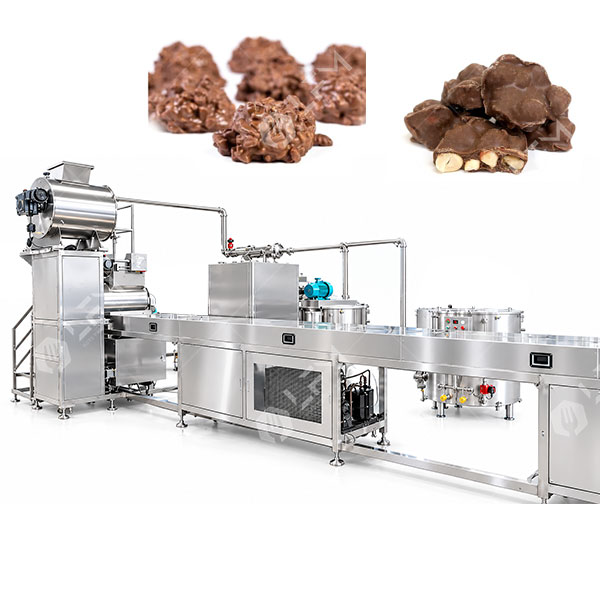
This industrial chocolate cluster making machine offers an efficient solution for processing chocolate mixtures into individual, crunchy clusters. The equipment expertly combines liquid chocolate with ingredients such as nuts, cereals, seeds, and dried fruits—enabling the production of items like peanut clusters, almond clusters, and more.
Equipped with a specially designed feed hopper and integrated mixing and spreading mechanisms, the machine ensures an even distribution of the mixture, resulting in consistent and reliable forming of the chocolate clusters.
As a provider of chocolate production solutions, LFM can tailor a complete chocolate cluster production line to your specific recipes, production requirements, and factory layout.
How Does the Industrial Chocolate Cluster Machine Work?
The chocolate cluster making machine uses a quantitative depositing process to divide chocolate mixtures containing nuts, cereals, seeds, or dried fruits into individual portions. After depositing, the products pass through a cooling system to solidify and develop their final shape.
The complete production process generally consists of five stages:
chocolate & ingredient preparation – mixing – feeding & quantitative depositing – cooling & setting – finished chocolate clusters
1. Chocolate and Ingredient Preparation
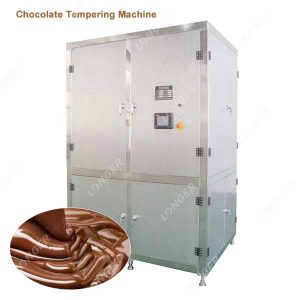
First, place the chocolate into a melting pot and tempering machine to melt and temper it, bringing it to the required state for processing. Meanwhile, prepare the ingredients—such as nuts, grains, seeds, and dried fruits—according to the product recipe.
Ingredients may be roasted, cooled, chopped, or otherwise processed before entering the mixing stage, depending on the finished product requirements.
2. Uniform Mixing of Chocolate and Inclusions
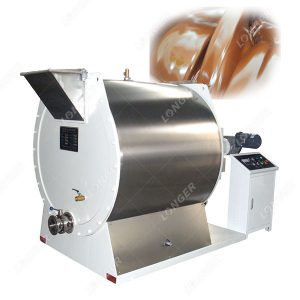
The prepared chocolate is combined with the selected solid ingredients in a suitable industrial mixer.
The mixing process distributes chocolate around the nuts and other inclusions while maintaining the desired ingredient texture. Depending on production requirements, additional mixing and dosing equipment can be configured for either batch-wise or continuous mixture preparation.
3. Specialized Feeding and Quantitative Depositing
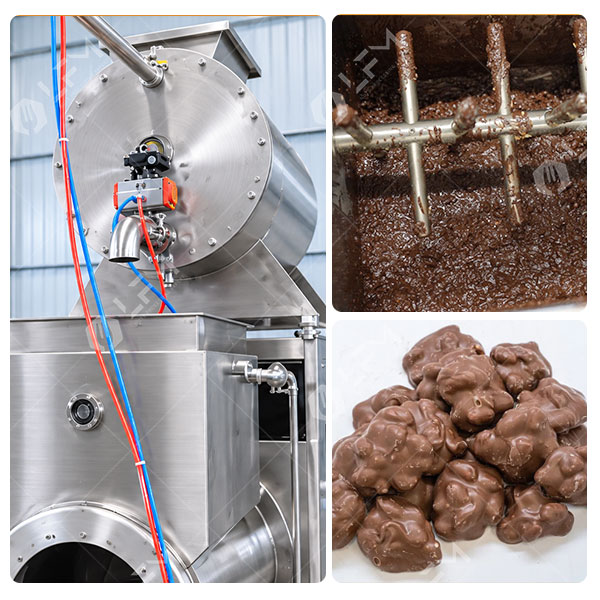
The prepared chocolate cluster mixture is transferred into a specially designed feeding hopper equipped with stirring and spreading devices.
These mechanisms help maintain an even distribution of the mixture and provide a stable material supply to the depositing section.
The machine then quantitatively deposits the mixture into individual portions according to the selected product specifications. This process helps manufacturers maintain consistent portion sizes and improve the uniformity of finished chocolate clusters.
4. Cooling and Setting
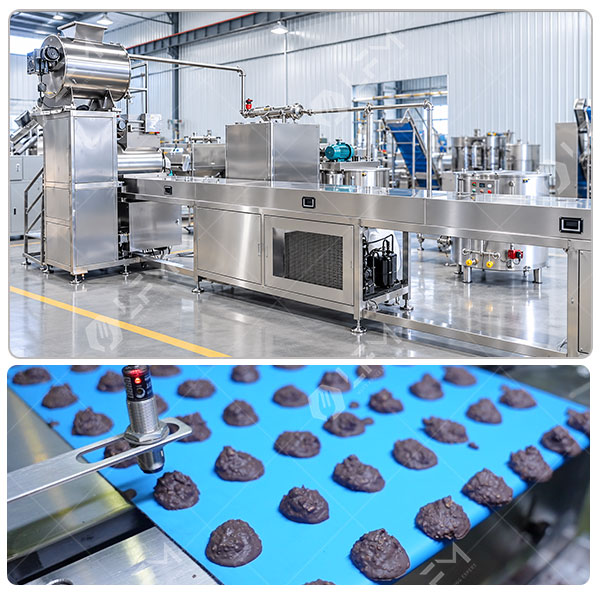
After depositing, the individual chocolate clusters are transferred to a cooling system, typically a cooling conveyor or cooling tunnel.
Controlled cooling allows the chocolate to solidify, helping the clusters maintain their shape and develop the desired texture.
Cooling conditions should be adjusted according to the chocolate formulation, product dimensions, and production speed.
5. Finished Product Output and Packaging
Once the chocolate clusters have sufficiently set, they are discharged for subsequent inspection and packaging.
Depending on the factory configuration, additional conveying, sorting, weighing, and packaging equipment can be integrated to establish a more efficient production workflow.
Key Features and Advantages of the Chocolate Nut Cluster Machine
1. Specialized Feeding System for Stable Material Supply
The machine features a specially designed feeding hopper equipped with stirring and spreading devices.
These mechanisms help distribute the chocolate mixture evenly and maintain a consistent supply to the depositing section. This is particularly important when processing mixtures containing nuts, cereals, seeds, and dried fruits, where uneven ingredient distribution may affect finished product consistency.
2. Quantitative Depositing for Consistent Cluster Portions
The quantitative depositing system divides the prepared chocolate mixture into individual portions according to the selected production specifications.
This helps improve portion consistency and reduce variations between finished products. It is particularly valuable for manufacturers producing standardized chocolate nut clusters for retail packaging and commercial distribution.
3. Integrated Cooling for Shape Setting
After depositing, the chocolate clusters enter the cooling stage, where the chocolate gradually solidifies and the products develop their final structure.
Following the depositing process, the chocolate clusters are transported on a PU conveyor belt into a cooling tunnel. As they pass through, the chocolate gradually solidifies, allowing the products to set into their final form.
The conveyor belt width ranges from 600 to 1200 mm, and the cooling tunnel length spans 10 to 18 meters. Both dimensions can be flexibly customized based on the specific chocolate recipe, product dimensions, and required production output.
4. Flexible Mixing and Dosing Configuration
Different chocolate cluster recipes require different ingredient combinations and preparation methods.
Additional industrial mixers and dosing devices can be supplied to support either batch-wise or continuous preparation of the cluster mixture.
This allows manufacturers to select a suitable processing configuration based on their recipes, production capacity, and factory layout.
5. Designed for Industrial Chocolate Cluster Production
The combination of specialized feeding, quantitative depositing, and cooling provides an efficient production approach for commercial chocolate cluster manufacturing.
This equipment can be integrated with chocolate melting tanks, tempering machines, holding tanks, and raw material processing systems, as well as downstream conveying and packaging equipment, to form a complete chocolate cluster production line.
Application of the chocolate cluster making machine:
- Chocolate Nut Clusters: This is one of the most common applications. Roasted peanuts, almonds, cashews, hazelnuts, or other nuts are mixed with chocolate to create a crunchy chocolate clusters.
- Chocolate Cereal Clusters: These are made by mixing chocolate with puffed rice, corn flakes, oats, or other crispy cereal ingredients. These products are commonly marketed as chocolate cereal bites, snack clusters, and convenient portion-sized treats.
- Chocolate and Dried Fruit Clusters: Dried fruits such as raisins, cranberries, and blueberries can be combined with chocolate and nuts to create products with contrasting flavors and textures.
- Mixed Seed Chocolate Clusters: Sunflower seeds, pumpkin seeds, sesame seeds, and other edible seeds can be incorporated into chocolate mixtures to produce distinctive cluster snacks.
Get a Customized Chocolate Cluster Production Solution from LFM
Choosing the right forming equipment can make a significant difference to production consistency, product flexibility, and factory efficiency.
Contact LFM to discuss your chocolate cluster manufacturing project. Share your target products, ingredient combinations, required output, and preferred cluster specifications. Our team can help evaluate your requirements and recommend a suitable machine for you.

Reviews
There are no reviews yet.